Overview
Automation is not a feature you toggle on across your entire customer journey. It is a prioritization decision. And most teams make it backwards, starting with what their tool can configure, not what their business most urgently needs to get right.
The result is a stack full of automations that do a lot and move nothing. Welcome sequences nobody opens. Re-engagement emails sent to customers who converted the day before. Onboarding drips that fire regardless of what the customer actually did in week one.
In Episode 10, we built the journey map: outside-in, stage by stage, with moments of truth explicitly identified and connected to execution logic. This episode picks up exactly where that left off. You have the map. Now the question is sequencing: which journeys do you automate first, and how do you know when one is actually ready?
Most teams answer that question by defaulting to whatever their platform makes easiest to configure. The result is a stack full of automations that run consistently and move almost nothing. Automation does not create leverage by existing. It creates leverage when the right action fires at the right moment in a journey that is already working. The framework below is built around that distinction.
The prioritization framework: impact vs. effort for journey automation
Every automation candidate has two dimensions worth measuring before a single workflow is built: how much impact it has on a metric that matters, and how much effort it genuinely takes to build, validate, and maintain correctly.
Map your candidates on both axes. High impact, low effort: build first. These are the workflows where signal clarity is strong, the response is validated, and the outcome is measurable within weeks. High impact, high effort: plan and resource properly. These are strategic builds, worth doing, but only with dedicated sprint allocation and named ownership. Low impact, low effort: fill gaps later, after the high-impact layer is live and measured. Low impact, high effort: do not build yet. This is the budget drain quadrant. Hyper-segmented nurture programs for audiences under 500. Complex personalization logic on low-traffic pages. Defer them or eliminate them from the roadmap entirely.
One dimension most versions of this framework leave out is what you might call the reversibility check. An automation that, if misconfigured, sends 40,000 customers a wrong-segment message or a broken link is not a low-effort build regardless of how fast the workflow took to configure. Effort must include the blast radius of getting it wrong.
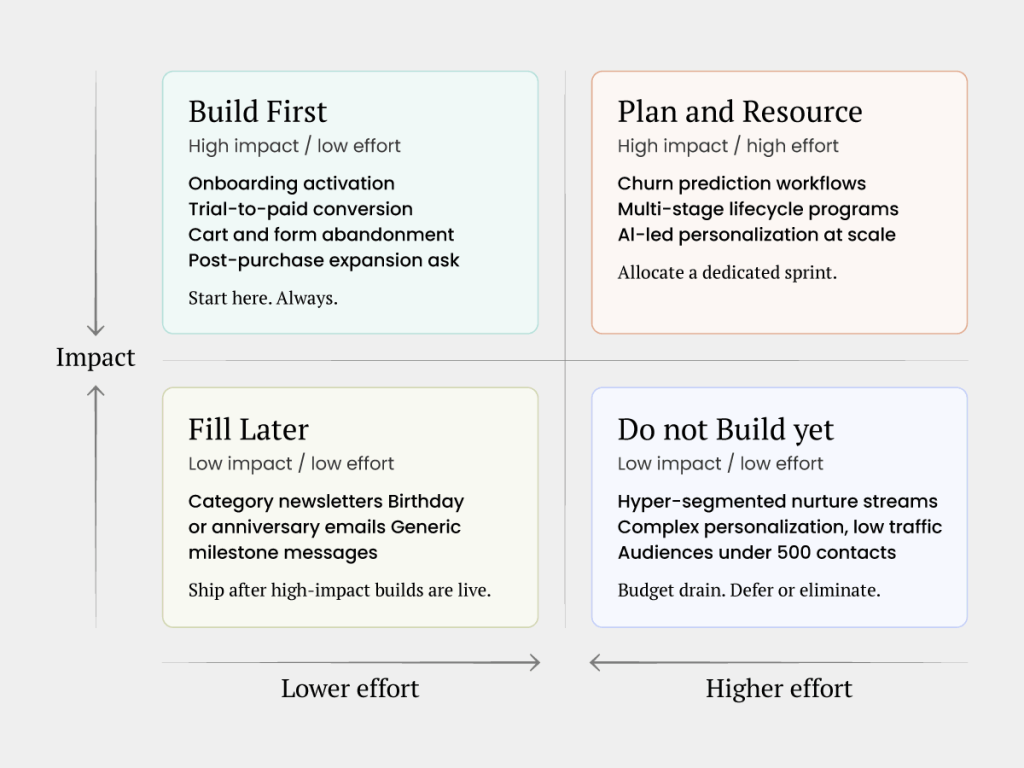
McKinsey research shows that personalization at high-intent journey moments drives a 10 to 15% revenue lift, with the range reaching 25% depending on sector and execution maturity. The prioritization framework is how you concentrate that lift on the journeys where it compounds, rather than spreading it across the entire lifecycle at shallow depth.
High-value journeys every business should automate first
Across industries, a concentrated set of journey moments generates disproportionate revenue risk and retention leverage. Five of them sit in the build-first quadrant for nearly every business, regardless of sector.
Onboarding activation is first. The 72-hour post-signup window determines whether a customer ever reaches value. Miss it and churn risk compounds daily. Trial-to-paid conversion is the highest-intent moment in the entire lifecycle; no other automation has a more direct line to recognized revenue. Abandoned consideration is the journey moment most teams underinvest in: the customer already did the hard work of evaluating, and one friction point, not disinterest, stopped the conversion. Early churn signal response requires acting on a feature usage drop before the window closes. Post-purchase expansion asks the right customer at the moment of peak satisfaction.
As Krish’s conversion funnel analysis guide makes clear, fixing checkout friction alone can yield a 35.26% increase in conversion rate: automation recovers that value, but only when it addresses the actual friction point, not just the fact of the abandonment.
| Journey | Why It Wins First | Signal That Triggers It |
|---|---|---|
| Onboarding activation | The 72-hour window after signup determines whether a customer ever reaches value. Miss it and churn risk compounds daily. | Key action not completed within N hours of account creation |
| Trial-to-paid conversion | The highest-intent moment in the entire lifecycle. No other automation will have a more direct line to revenue. | Trial expiry minus 3 days, plus usage depth signal |
| Abandoned consideration | The customer has already done the hard work of evaluating. One friction point stopped the conversion, not disinterest. | Cart or form abandonment after 45+ seconds on page |
| Early churn signal response | Feature usage drop in week 3 to 6 is the canary in the coalmine. By month 3 it is too late for a drip sequence. | Login frequency or feature engagement drops 40%+ week-over-week |
| Post-purchase expansion | Customers at peak satisfaction are statistically most likely to upgrade or refer. Most teams wait too long to ask. | NPS 9 to 10 or repeat purchase within 30 days |
How to identify high-frequency, high-impact customer behaviors
A signal is only valuable if it is specific, observable, and reliably predictive.
“Customer seems interested” is not a signal.
“Customer visited the pricing page three times in five days without clicking a CTA” is a signal.
The distance between those two statements is the entire gap between a functioning automation and an expensive noise machine.
Salesforce research shows 73% of customers expect companies to understand their unique needs. Signals are how you get there without asking every customer to explain themselves.
Three attributes determine whether a behavior is ready to trigger an automation:
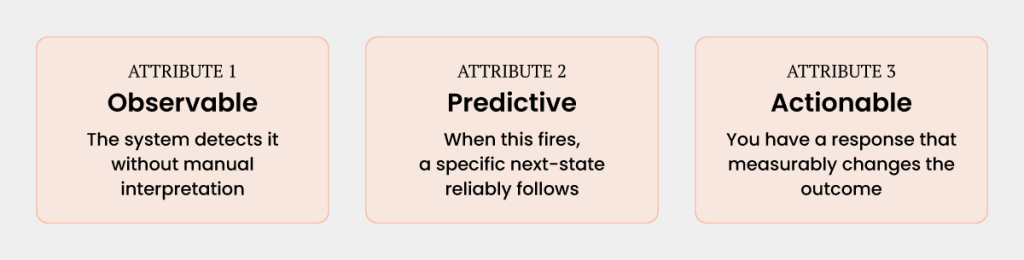
If a candidate trigger fails any one of these tests, it is not a trigger. It is a hypothesis. You do not automate hypotheses. You run them manually, validate that the response changes the outcome, then automate the proven workflow.
The four benchmark thresholds that give signal identification its precision in practice:
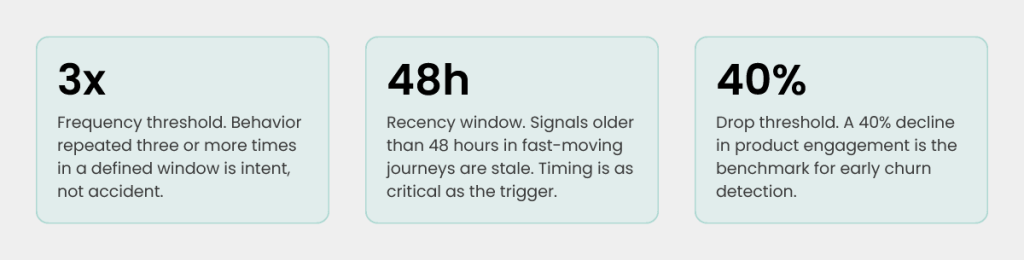
Finding these signals requires one discipline most teams avoid: working backward from outcomes, not forward from behaviors. Pull your churned customer cohort. What did their behavioral data look like at day 14? What signal was present that no automation acted on? That pattern, confirmed across enough cases, is your trigger.
Mapping trigger events that signal readiness for automation
Not every signal that is observable is worth building on. The sequencing of how you confirm a trigger is ready matters as much as finding the signal in the first place.
As Gartner notes, 55% of customer service leaders currently use some form of journey analytics, and expect it to be among the top five most valuable technologies for their function within two years. The operational shift from data to trigger-ready execution is where that value actually lives.
For each automation candidate, confirm the following before anything is built:
- One defined signal that fires at the right moment in that specific stage
- One defined response with a validated hypothesis that it changes the outcome
- One named owner on the execution side who can monitor, catch errors, and suppress when conditions change
- One suppression rule that prevents the automation from firing if the customer has already converted or exited the relevant stage
That last point is the one most teams skip. Suppression logic is as important as targeting logic. If a customer converts between the moment a signal fires and the moment the automation executes, a poorly suppressed follow-up is actively worse than no follow-up. It signals that your system does not know what the customer just did.
Never automate a broken process. Fix it first.
The diagnostic before any automation build is not “can we automate this?” It is “is the underlying journey working?”
A journey is working when a meaningful percentage of customers who enter it complete it without friction that requires human intervention to resolve.
Before automating any journey, run it manually. Watch five to ten customers move through it in real time. Document where they hesitate, where they ask questions, where they drop. Fix those points. Then automate.
- If customers cannot complete onboarding without a support ticket, do not automate the onboarding drip. Fix the product gap first.
- If your trial-to-paid conversion rate manually is below 10%, an automated email sequence will not save it. Investigate the conversion blocker first.
- If churn happens in month one regardless of CS intervention, you have a product-fit problem, not an automation problem.
- Automation is a multiplier. It multiplies what is already working. It also multiplies what is already broken.
McKinsey analysis of agentic AI in marketing and sales found that organizations realizing meaningful impact are redesigning workflows around automation, not bolting automation onto legacy processes. That principle applies at every level of automation maturity, not just at the AI frontier. The sequencing is always: fix the process, validate the journey, then automate at scale.
The automation amplification problem
Automation does not fix a broken customer experience. It institutionalizes it. If your manual onboarding process has a friction point that causes 30% of customers to stall, automating that process at scale creates a system that reliably stalls 30% of customers faster and more efficiently than before.
Closing: Sequence before you scale
The question is never which journeys can be automated. Almost any journey can. The question is which journeys are ready, and in what order do automating them compound into measurable business outcomes.
Start with the five priority journeys. Run the impact-effort matrix against your specific stack and customer base. Validate every trigger against the three-attribute test before a workflow is built. And fix the broken process before you hand it to the automation layer.
The right automation, at the right moment, for the right customer. Everything else is system noise.
Table of Content
- Overview
- The prioritization framework: impact vs. effort for journey automation
- High-value journeys every business should automate first
- How to identify high-frequency, high-impact customer behaviors
- Mapping trigger events that signal readiness for automation
- Never automate a broken process. Fix it first.
- Closing: Sequence before you scale
Subscribe with Us!
Never miss any post, stay tuned!

Ankit helps brands navigate their digital maturity journey by bringing together analytics, CRO, ML, and AI in a practical, business-friendly way. Having worked with global teams across industries, he focuses on simplifying complex MarTech concepts and turning them into measurable outcomes. On weekends, you’ll likely find him deep in a reflective read or sharing a coffee with a client while simplifying MarTech in the most human way possible.
Recommended Reading:
Personalization at Scale: Moving Beyond First Name Tokens – MarTech Masterclass Series Ep | 12
11 February, 2026 Most brands have already accepted that personalization matters. The numbers make that case clearly. McKinsey confirmed long back that personalization most often drives 10% to 15% revenue lift, with company-specific lift spanning 5% to 25%, driven by sector and ability to execute. Companies that grow faster even drive 40% more of their revenue from personalization than their slower-growing counterparts.
Subscribe with Us!
Never miss any post, stay tuned!
Trusted by leading brands


